
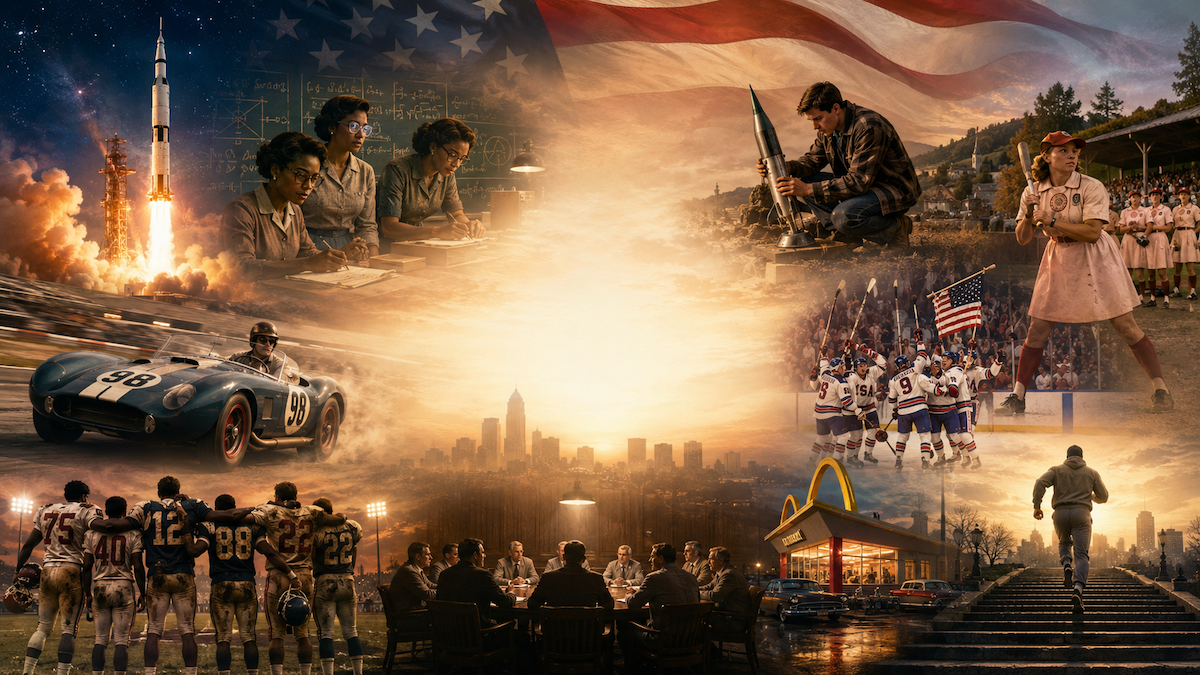
We All Know The 4th of July WAR Movies, But Try These Movies That Celebrate America Instead
On July 4, 2026, the United States marks the 250th anniversary of the adoption of the Declaration of Independence.
That is a big birthday for a country that has never been particularly quiet, simple, or easy to explain.
So rather than put together another list of war movies, battlefield victories, flag-waving speeches, and presidents staring nobly into the middle distance, we wanted to look at something more interesting: the qualities that make America worth celebrating.
Ingenuity. Ambition. Courage. Reinvention. Civic responsibility. The ability to challenge authority, get knocked down, get back up, and occasionally build a rocket in the backyard because everyone in town says you cannot.
These movies do not claim that America has always lived up to its ideals. Several of them exist precisely because it has not. Instead, they celebrate the people who pushed the country forward, solved impossible problems, widened opportunity, and demanded that America become the nation it promised to be.
Here are ten movies that capture the best of the American spirit.
1. Apollo 13 (1995)
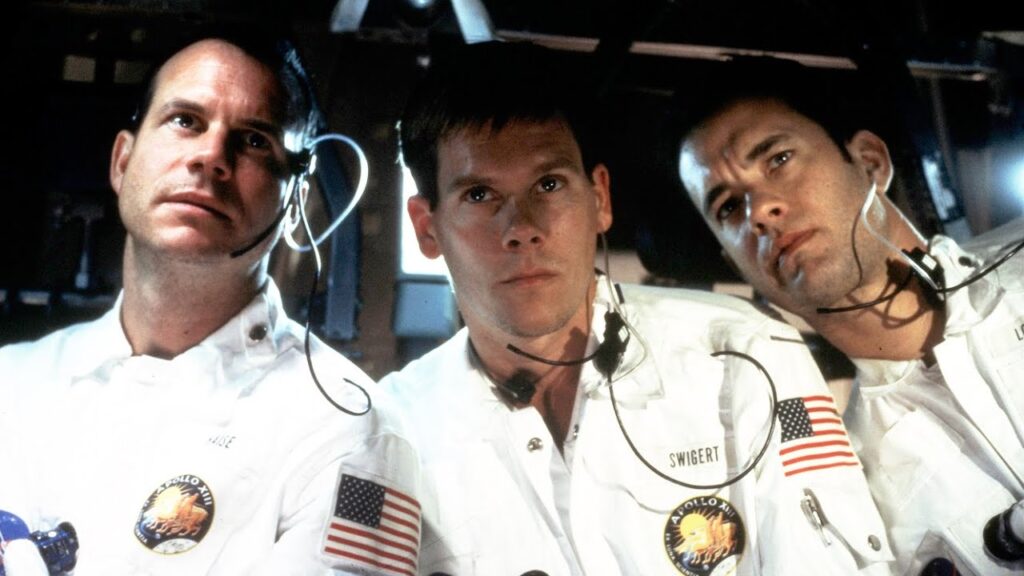 American Ingenuity Under Pressure
The Apollo 13 mission began in April 1970 as what was supposed to be humanity’s third landing on the moon. By then, the space program had already started to feel almost routine to much of the public. The thrill of Apollo 11 had passed, the Vietnam War dominated the national conversation, and interest in another moon mission had begun to fade.
Then an oxygen tank exploded.
Suddenly, the mission was no longer about reaching the moon. It was about bringing three astronauts home alive.
When Ron Howard’s Apollo 13 arrived in 1995, it transformed that rescue into one of the great American procedural thrillers. The film has no villain, no conspiracy, and no miraculous last-minute invention pulled out of nowhere. Its heroes are astronauts, engineers, mathematicians, technicians, and flight controllers doing their jobs exceptionally well while the margin for error disappears around them.
That is what makes the film so distinctly American. Survival comes through teamwork, public investment, technical knowledge, improvisation, and the refusal to accept that a terrible situation must become a fatal one.
The movie received nine Academy Award nominations, including Best Picture, and won for Film Editing and Sound. More importantly, it made intelligence cinematic. A room full of people working through equations, electrical limits, air filters, and orbital trajectories became every bit as suspenseful as a car chase.
At a time when American movies increasingly celebrated lone heroes, Apollo 13 reminded audiences that some of the country’s greatest accomplishments came from thousands of people working together toward a common goal.
2. Hidden Figures (2016)
The Americans History Left Out
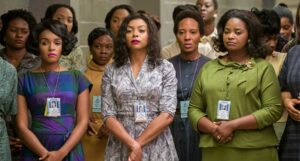 For decades, popular culture presented the early American space program through a familiar image: white male astronauts, white male engineers, white male flight controllers, and perhaps a few concerned wives waiting at home.
Hidden Figures expanded that picture.
Released in 2016, the film brought overdue attention to Katherine Johnson, Dorothy Vaughan, Mary Jackson, and the Black women mathematicians whose calculations and technical expertise were essential to the success of the early space program.
The timing mattered. Conversations about representation, historical erasure, and who gets recognized as an American hero were becoming increasingly prominent. Hidden Figures did not simply place Black women inside an existing national story. It showed that they had been central to that story all along.
The film became both a commercial success and an awards contender, receiving three Academy Award nominations, including Best Picture. Its impact extended well beyond the ceremony. NASA embraced the renewed attention surrounding the women, and the real figures behind the story received further national recognition in the years that followed.
What makes Hidden Figures such an important film for America’s 250th is that it celebrates achievement without ignoring the barriers placed in front of the achievers.
These women helped send Americans into space while working inside institutions shaped by segregation and sexism. Their brilliance was undeniable, but brilliance alone was not enough. They also had to be persistent, strategic, adaptable, and better prepared than the people allowed to underestimate them.
The film argues that American greatness is not diminished when forgotten contributors are finally recognized. It becomes more complete.
3. October Sky (1999)
A Dream Bigger Than the Town That Raised You
 When the Soviet Union launched Sputnik in 1957, the small satellite did more than begin the space race. It jolted an entire generation of American students, scientists, and political leaders into looking upward.
One of those students was Homer Hickam, a teenager growing up in the coal-mining town of Coalwood, West Virginia.
Released in 1999, October Sky tells the story of Homer and his friends teaching themselves how to build rockets in a community where a young man’s future was usually decided long before graduation. You worked in the mine because your father worked in the mine, and because there were not many other roads available.
The film arrived near the end of the twentieth century, when many American industrial communities were already facing decline, job losses, and an uncertain future. That context gives the movie more weight than the standard follow-your-dreams formula.
Homer is not rejecting his hometown because he believes he is better than it. He is trying to imagine a future that the town cannot yet see for him.
October Sky was warmly received, but it was never a massive blockbuster or awards-season juggernaut. Its reputation grew more quietly. It became the kind of film passed between teachers, parents, students, and anyone who needed a reminder that curiosity can become a way out.
The movie celebrates education not as an abstract virtue, but as a form of liberation. A dedicated teacher recognizes potential. Friends learn through failure. A kid repeatedly blows things up until he finally understands why they exploded.
That is American stick-to-it-iveness in its purest form.
4. Ford v Ferrari (2019)
Build It Better, Then Fight the Committee
 In 1966, Ford Motor Company set out to defeat Ferrari at the 24 Hours of Le Mans, one of the most punishing automobile races in the world.
That required more than corporate money and executive swagger. It required designer Carroll Shelby, driver and engineer Ken Miles, a team of mechanics, and an automobile capable of surviving speeds and stresses its creators were still learning to understand.
Released in 2019, Ford v Ferrari arrived during a Hollywood era dominated by superheroes, shared universes, digital spectacle, and intellectual property. James Mangold delivered something that felt almost rebellious in its simplicity: an adult studio drama about men building a machine, testing it, breaking it, fixing it, and trying again.
Audiences responded to that craftsmanship. The film earned a Best Picture nomination and won Academy Awards for Film Editing and Sound Editing, two categories that perfectly reflect what made its racing sequences so effective.
But the movie is not merely a celebration of horsepower or corporate victory. In fact, Ford executives spend much of the story making life harder for the people actually doing the work.
That friction is essential to why the movie belongs here.
Ford v Ferrari captures one of the great contradictions of American achievement. The country can create extraordinary things because talented, obsessive people are given resources and freedom. It can also nearly destroy those things through ego, bureaucracy, marketing decisions, and people in suits who have never turned a wrench.
Shelby and Miles succeed because they question conventional thinking. They listen to the machine, trust experience, challenge authority, and refuse to settle for something that merely looks impressive.
They want to build something that works.
5. A League of Their Own (1992)
When the Country Needed Them, Women Stepped Up
 During World War II, with many male professional baseball players serving overseas, women were recruited to keep professional baseball alive.
That remarkable chapter of American sports history became the foundation for Penny Marshall’s 1992 film A League of Their Own.
The movie arrived at a time when major Hollywood sports films still overwhelmingly centered men. Rather than treat its female players as a novelty, it gave them the full sports-movie treatment: rivalries, sacrifice, comedy, bruised egos, difficult coaches, championship pressure, and the complicated realization that success does not mean the same thing to everyone.
The film was a commercial success, produced one of the most quoted lines in movie history, and developed an even stronger reputation over time. In 2012, it was added to the National Film Registry for its cultural, historical, and aesthetic significance.
Its staying power comes from the way it balances celebration with melancholy.
The women are told they are saving baseball, but they are also expected to remain attractive, polite, and disposable. They are given an opportunity because the country temporarily needs them, then pushed aside when the old order returns.
Still, what they accomplish cannot be erased.
A League of Their Own celebrates American resilience while exposing how selectively the country has handed out opportunity. These women do not simply fill in for men. They prove they belonged on the field all along.
6. Miracle (2004)
Do You Believe in Miracles?
 At the 1980 Winter Olympics in Lake Placid, the United States men’s hockey team faced a Soviet team widely regarded as the best in the world.
The Soviets were not simply another opponent. They had dominated international hockey for years, defeating even teams composed of experienced NHL players. The American roster, by contrast, was built largely from young college athletes who had little reason to believe they could compete with such a disciplined and experienced machine.
Yet coach Herb Brooks believed they could.
Released in 2004, Miracle arrived in an America still living through the aftermath of September 11 and the uncertainty of wars in Afghanistan and Iraq. Its story of national unity, sacrifice, and an underestimated team overcoming seemingly impossible odds had obvious emotional power.
The movie could easily have become chest-thumping propaganda. Instead, it focuses on preparation.
Brooks is not portrayed as an inspirational mascot. He is relentless, demanding, emotionally distant, and willing to make his players hate him if that hatred will force them to become a team.
Kurt Russell delivers one of the best performances of his career, capturing both Brooks’ tactical intelligence and the personal cost of his obsession. The film received generally positive reviews and steadily grew into a modern sports-movie staple.
What makes Miracle worthy of this list is that the victory is not presented as destiny.
The Americans do not win simply because they are Americans. They win because they train harder, adapt faster, trust each other, and refuse to be intimidated by an opponent everyone else considers unbeatable.
The result became one of the defining moments in American sports history, but the movie’s deeper message is even more enduring.
Belief matters.
Preparation matters more.
7. Remember the Titans (2000)
Becoming a Team Before Becoming Champions
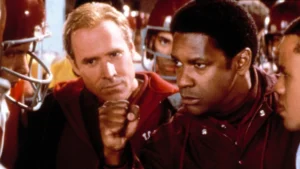 In 1971, T.C. Williams High School in Alexandria, Virginia, integrated its football program during a period of intense racial tension.
The players were expected to become teammates while the adults around them were still struggling to accept that they belonged in the same classrooms, neighborhoods, and community.
Released in 2000, Remember the Titans arrived at a moment when Hollywood had rediscovered the inspirational sports drama. But its appeal went well beyond football.
Denzel Washington’s Coach Herman Boone and Will Patton’s Coach Bill Yoast represent two leaders forced to navigate competition, resentment, politics, and the difficult process of building trust across racial lines.
The movie takes liberties with the historical record, as many based-on-a-true-story films do. Its version of events is cleaner and more dramatically concentrated than reality.
Still, the emotional truth of the film resonated strongly with audiences.
Remember the Titans became a major commercial success and one of the most beloved sports films of its era. It has remained a fixture in classrooms, locker rooms, team buses, and any setting where someone needs a speech about unity before taking the field.
What earns it a place on this list is not the undefeated season.
It is the idea that Americans do not have to begin from the same place to move forward together.
The players do not erase their differences. They learn each other’s names, histories, fears, and strengths. They become better because they are forced to rely on people they had previously been taught to distrust.
That is not an easy vision of America.
It is an optimistic one.
8. 12 Angry Men (1957)
Democracy in a Jury Room
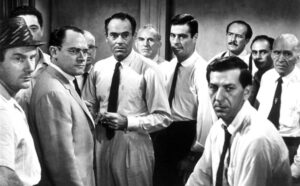 Released in 1957, 12 Angry Men arrived during an era shaped by Cold War paranoia, conformity, institutional fear, and the lingering effects of McCarthyism.
Its setting could hardly be smaller. Twelve jurors sit inside a hot room and debate whether a young defendant should be convicted of murder.
There are no courtroom theatrics, no surprise witnesses, and almost no action beyond men talking, arguing, sweating, and slowly revealing their prejudices.
Yet few films have presented a more compelling portrait of American civic responsibility.
The movie received three Academy Award nominations, including Best Picture, Director, and Screenplay. Its standing grew considerably in the decades after its release, and it was added to the National Film Registry in 2007.
The film’s power lies in its understanding that democracy is not self-executing.
Justice depends upon citizens who are willing to listen, think, question assumptions, and remain in an uncomfortable room long after everyone else wants to go home. One juror does not declare the defendant innocent. He simply asks whether the evidence deserves another look.
That modest act of doubt changes everything.
12 Angry Men does not argue that American institutions are automatically fair. It argues that they can become fair only when the people inside them take their responsibilities seriously.
That may not be the loudest form of patriotism, but it is one of the most important.
9. The Founder (2016)
The American Dream, Supersized
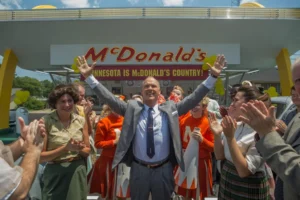 By the middle of the twentieth century, America was changing rapidly.
Suburbs were growing, highways were expanding, families were driving farther, and consumers increasingly expected speed, consistency, and convenience. Into that world came the McDonald brothers, who reimagined how a restaurant could operate.
Their Speedee Service System transformed a kitchen into something closer to an assembly line. Burgers, fries, drinks, and milkshakes could be prepared quickly, consistently, and on a scale that traditional drive-ins could not match.
Then Ray Kroc saw what they had built.
Released in 2016, The Founder tells the story of how Kroc turned one innovative California restaurant into one of the most recognizable brands on Earth.
Michael Keaton gives Kroc enormous charm, hunger, resentment, and menace. He is both an American success story and a warning about what success can demand from the people who pursue it.
The film was well received critically, with Keaton’s performance earning particular praise, though it never became a major box office hit. Its reputation has grown as audiences have become increasingly interested in stories about brands, corporations, start-ups, and the morally complicated figures who build them.
The Founder belongs on this list because it captures both sides of American ambition.
The McDonald brothers represent ingenuity, craftsmanship, and the ability to rethink an entire industry. Kroc represents persistence, salesmanship, scale, and the ruthless conviction that a good idea can become something much larger.
Together, they create a story that is uniquely American.
Build something better.
Find a way to expand it.
Then argue over who gets to own the dream.
10. Rocky (1976)
The Victory Is Going the Distance
 Rocky arrived in 1976, the year of America’s Bicentennial.
It was also a bruised moment in the country’s history. The optimism of the postwar era had faded. The nation was emerging from Vietnam and Watergate, major cities were struggling, and many Americans had begun to feel that the future might not be better than the past.
Into that mood walked Rocky Balboa, a small-time Philadelphia fighter who is given a shot at the heavyweight championship because the reigning champion needs an opponent.
Nobody expects Rocky to win. More importantly, Rocky does not need to win.
His goal is to remain standing until the final bell, to prove that he is not simply another forgotten man drifting through a life that never quite began.
The film became a cultural phenomenon and won the Academy Award for Best Picture over a field that included Network, Taxi Driver, All the President’s Men, and Bound for Glory. John G. Avildsen won for directing, the film also won for editing, and Sylvester Stallone received acting and screenwriting nominations for the same movie.
In 2006, Rocky was added to the National Film Registry. The movie’s greatness comes from its refusal to confuse success with domination.
Rocky does not conquer the world. He earns his own respect. He trains before sunrise, runs through streets that barely notice him, takes every punch, and keeps moving forward.
That is the American underdog story stripped down to its essence.
Final Pour
These ten movies offer ten different versions of America.
The scientists who bring astronauts home.
The women whose calculations helped launch a nation into space.
The student who looks beyond the coal mine.
The engineers who build a faster machine.
The baseball players who step onto a field that was never supposed to belong to them.
The hockey players who confront the unbeatable.
The football team that learns how to become one.
The juror who asks one more question.
The entrepreneurs who reshape the way a nation eats.
The fighter who simply wants to prove that he belongs in the ring.
None of these stories says America is perfect.
They say America is capable.
Capable of invention, courage, reinvention, teamwork, progress, and the occasional miracle created by people who refuse to quit.
At 250, the United States remains unfinished, contradictory, frustrating, inspiring, and perpetually under construction.
Maybe that is what makes it such a great movie story.
Happy birthday, America. 🍸🍿
Ten More Movies to Celebrate America at 250
Still looking for something to watch after the fireworks? These ten films offer even more stories of American ingenuity, ambition, resilience, reinvention, and the determination to keep going when the odds say otherwise.
The Right Stuff (1983)
Tucker: The Man and His Dream (1988)
Field of Dreams (1989)
Rudy (1993)
Seabiscuit (2003)
The Pursuit of Happyness (2006)
Akeelah and the Bee (2006)
Moneyball (2011)
Sully (2016)
The Post (2017)
However you spend the Fourth, these movies are a reminder that America’s best stories are rarely about perfection. They are about people who dream bigger, work harder, question the rules, and refuse to quit. 🍸🍿